Build a paper town using only two colors and one open street
A small paper town becomes easier to invent when the palette is limited. Use two available colors and leave one open street through the composition. This original activity is about deciding how shapes meet, overlap and leave space, rather than copying a real place or designing a workable building.
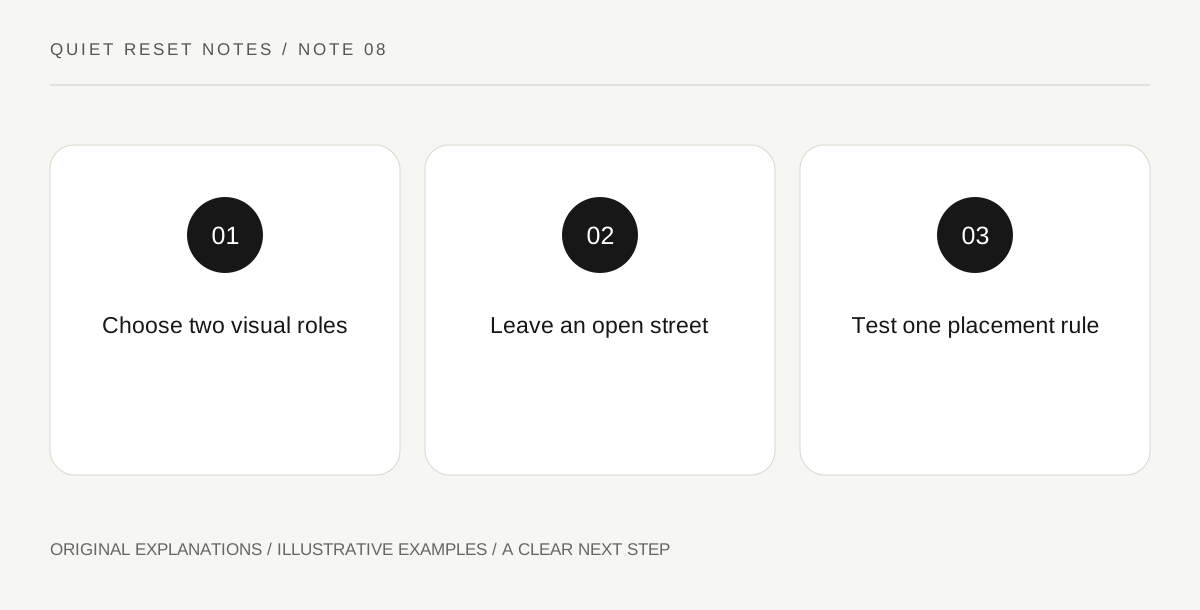
Original explanatory diagram. Read the full method and limitations below.
Choose the available pair
Use clean scraps already at hand, or draw with two comfortable colors instead of handling paper pieces. The colors do not need to be complementary or fashionable. The Gallery’s color resource offers background on artistic relationships; no universal emotional effect is assigned to this pair. Place the materials on a small plain background. Decide which color will appear more often and which will be an accent, simply to give the first arrangement a clear starting choice.
Leave the street before adding buildings
Imagine a path across the page and keep it open. Place a few broad shapes on either side, leaving gaps where you want them. A rectangle can suggest a building without windows or architectural detail. Let the second color mark a doorway, roof or separate block. Avoid filling every blank place. The street can bend or widen, and it does not have to obey the dimensions of a real road. It is a visual space connecting the invented town.
Change one neighborhood rule
Choose a small rule to test, such as keeping all accent pieces on one side or placing them only near the street. Move a few pieces and compare the result before fixing anything. If working in pencil or crayon, make a second tiny version beside the first. The point is to see how a limited palette can still produce different arrangements. Do not introduce a third color just because the first idea does not look like an online example.
Add an imaginary place name
Give the town a name drawn from its visible arrangement, such as Long Street or Two Roofs. You can write one line about an invented shop or square without mapping a complete city. Keep the pieces loose if movement was the enjoyable part, or fix your own paper with an appropriate familiar adhesive if you want a card. Put the materials away after one composition. The town can be complete on the page without becoming a larger model-making obligation.
An illustrative small session
In an illustrative session, blue rectangles form most of a town and a few ochre scraps mark doors beside one open street. The maker tries moving all ochre pieces to the left side, prefers the earlier arrangement and leaves it loose. This invented example describes a palette game and makes no claim that either color has a guaranteed calming effect.
Questions that come up
Must the town look realistic?
No. Broad shapes and an open street can suggest a place without perspective, accurate buildings or a complete map. The town is an invented composition rather than an architectural plan.
What if I have only a pencil?
Use two different marks, such as outlined and lightly shaded shapes, instead of two colors. The limited-choice structure can remain while the materials change to suit what is available.
References and scope
These sources support the factual background. Examples and exercises are original illustrative teaching material. References do not imply endorsement.
- National Gallery of Art — shape — Geometric and organic shapes and composition vocabulary.
- National Gallery of Art — color — Color relationships and varied artistic choices; no universal emotional effect is claimed.