Make a five-piece tabletop puzzle that has more than one answer
Most puzzles ask for the right solution. This original paper version asks what several arrangements can become. Use five broad clean pieces, set a small imaginary frame and make two different answers without changing the pieces. The interest lies in choosing a relationship, not completing a timed challenge or matching a hidden reference.
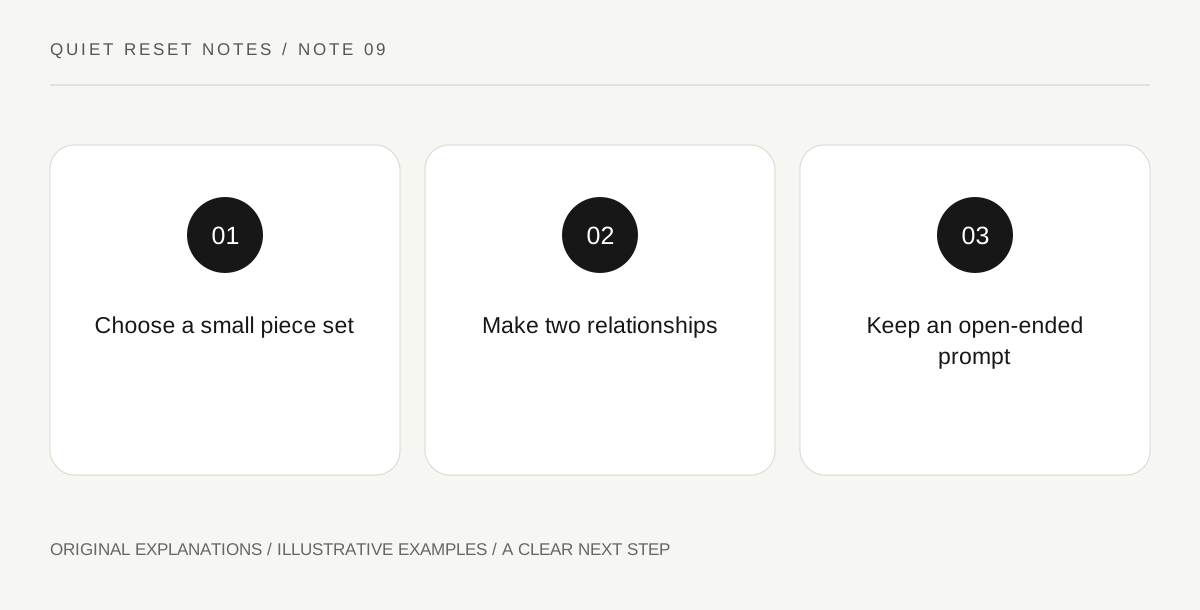
Original explanatory diagram. Read the full method and limitations below.
Make the playing area modest
Choose five existing paper scraps that are easy to move and place them on a clear stable surface. Use a sheet underneath to suggest the boundary, leaving room to handle the pieces comfortably. The Gallery’s shape vocabulary is useful background, but there is no official puzzle to reproduce. Avoid tiny pieces if they are awkward for you or unsuitable around children or animals. Fewer larger pieces can serve the same design idea without preserving a prescribed count.
Choose the first answer’s description
Give yourself a broad description such as an opening, a cluster or a path. Arrange the pieces until the description makes sense to you. Overlap is available if the surface and pieces allow it, but no glue is needed. Leave some background visible so relationships are easier to see. You do not have to make a recognizable object. A composition that suggests a passage between two groups is a perfectly usable first answer.
Change the relationship rather than the materials
For the second answer, keep all the same pieces but choose a different description. An opening might become a closed group, or a straight path might become a curved chain. Move pieces deliberately and notice which change has the largest effect. There is no need to exhaust every possible arrangement or prove that your second version is better. Two clearly different relationships provide enough comparison for one small session.
Give the puzzle a reusable prompt
Write your two descriptions on a scrap and keep it with the pieces if you want to repeat the game later. Another session can begin from those descriptions or invent new ones. If sharing with a companion, let them make their own arrangement before explaining yours so neither version becomes an answer key. Restore the surface when finished. The small set can stay reusable without leaving a half-completed puzzle that someone feels obliged to solve.
An illustrative small session
Imagine five broad scraps first making a narrow passage and then a closed cluster. Their maker records only those two descriptions, puts the pieces in an envelope and leaves no fixed solution. On another day a companion could interpret the same prompts differently. The invented scenario describes an open-ended composition game, not a cognitive test or evidence of improved concentration.
Questions that come up
Does the activity require exactly five pieces?
No. Five is the original prompt’s small working set, not a rule you must preserve. Use fewer larger pieces if that makes the handling more comfortable or suitable for your setting.
How do I know whether I solved it?
There is no hidden correct layout. The session is complete when you have explored the chosen descriptions enough to stop, even if the arrangements remain abstract or temporary.
References and scope
These sources support the factual background. Examples and exercises are original illustrative teaching material. References do not imply endorsement.
- National Gallery of Art — shape — Geometric and organic shapes and composition vocabulary.