Rotate one simple paper motif to make four different corners
A repeated shape changes character when it turns. Make or choose one broad paper motif, then use it to explore four orientations on a small page. This original composition exercise needs no cutting precision or complex symmetry vocabulary; it asks only what happens when the same shape faces another direction.
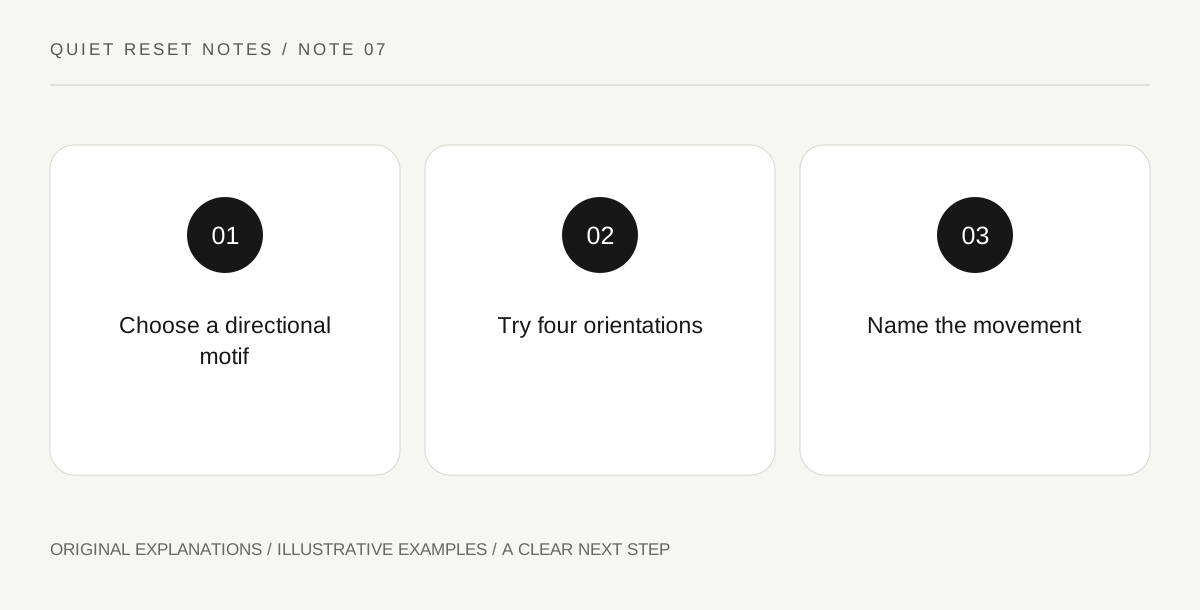
Original explanatory diagram. Read the full method and limitations below.
Choose a shape with a visible direction
Use a clean loose paper piece with a broad bend, notch or uneven side. A perfectly symmetrical circle will make rotation harder to notice, so choose something with a clear directional feature. Place it on a plain sheet and leave space around it. The Gallery’s line and shape references explain general visual elements; the four-corner recipe is our own. If making the shape is awkward, use an existing scrap rather than turning preparation into the main activity.
Try the first two orientations
Place the motif near one corner, then turn it and place it near another. Observe how its open or projecting side seems to point into or out of the page. You can trace loosely with a comfortable tool, draw an approximate copy or simply move the original piece. Exact duplication is unnecessary. Keep the same broad shape so that orientation remains the main difference, rather than changing its design every time you move it.
Complete a loose family of four
Try two more positions or orientations, leaving a clear open center. The four versions can appear to gather inward, move outward or alternate. There is no correct arrangement. If the page becomes crowded, reduce the scale of an approximate drawn copy or use a larger scrap sheet already available. You do not need to measure a perfect grid. A loose family can make the relationship visible while keeping the handling and drawing comfortable.
Choose a title from the movement
Give the set a descriptive title such as turning inward or four open corners. If you want another round, change only the spacing and see how the same motif relates to the empty center. End before you begin adjusting every small edge. The activity is a comparison of orientations, not a precision-printing task. Keep the motif with the page if you want to revisit it, or return the paper to your scrap collection when the session is complete.
An illustrative small session
Imagine a reader choosing an L-like scrap. Four loose drawn versions point toward the center of a page, making a frame without touching. They call it open courtyard and stop after one spacing change. The invented example demonstrates orientation and arrangement, not a prescribed pattern, an art-history attribution or a tested effect on stress.
Questions that come up
Do I need identical cutouts?
No. You can move one piece, trace it loosely or make approximate drawn copies. The relationship of directions matters more than exact duplication or precise cutting.
What if rotation looks almost the same each time?
Choose a less symmetrical shape or add one clear directional feature in a drawing. You can also keep the subtle result; the activity does not require a dramatic visual transformation.
References and scope
These sources support the factual background. Examples and exercises are original illustrative teaching material. References do not imply endorsement.
- National Gallery of Art — shape — Geometric and organic shapes and composition vocabulary.
- National Gallery of Art — line — Line as an element of visual art; supports vocabulary, not a therapeutic outcome.