Move three paper shapes between two imaginary scenes
Three loose paper shapes can become more than one small picture without adding materials. Arrange them once as a scene, then rearrange the same pieces into something different. This original paper game keeps the interesting part in the movement between versions, so there is no need to glue the first arrangement down.
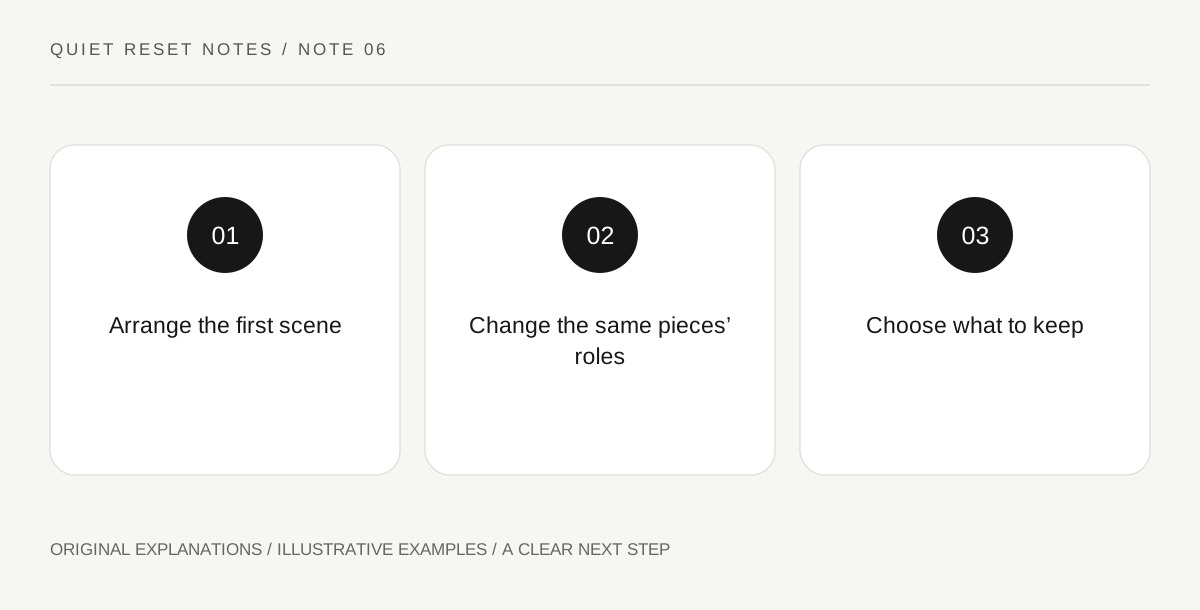
Original explanatory diagram. Read the full method and limitations below.
Make a small reusable set
Choose clean scrap paper you can comfortably handle. Use three existing pieces or gently tear suitable paper into broad shapes; sharp tools are not required. Put them on a contrasting sheet or clear surface. The National Gallery’s shape resource supplies background vocabulary for geometric and organic forms, while this three-piece scene game is our own. Avoid important documents or printed personal information. A small set is enough to begin because the pieces can change their meaning when their positions change.
Give the first arrangement a setting
Place the pieces to suggest an invented scene, such as a tiny harbor, a hill with a building or an abstract room. Let one shape play a different role from its literal outline. A long strip can be a horizon, a broad piece an island and a small curve a boat. Leave the scene simple enough to recognize through your own short description. You are not trying to make every viewer guess it correctly without any explanation.
Reuse every piece in a different role
Move the same pieces into another scene and try changing at least one role. The horizon could become a tower, the island a roof and the boat a cloud. Rotate or overlap pieces where the surface allows, but do not add more merely to solve every visual problem. The fixed set gives the second arrangement its playful constraint. If no scene appears, make an abstract composition and name its balance instead of forcing a realistic subject.
Keep one record or none
You can sketch the two arrangements, photograph your own paper if desired or simply put the three pieces in an envelope for another day. Gluing is optional and changes the game from rearranging to keeping one version. Choose that only if you want a fixed picture. The activity can finish after the second scene, with the pieces restored and the surface clear. A temporary arrangement has still been a complete creative session even when it leaves no permanent artwork.
An illustrative small session
In an invented session, a strip, a broad rounded piece and a small triangle first become a harbor. Turned and moved, they become a tower, a roof and a hill in a different scene. The maker keeps the loose pieces instead of gluing either version. This example explains the game and does not claim that a particular arrangement produces calm or improves a measured skill.
Questions that come up
Must the pieces be recognizable objects?
No. Broad abstract shapes are useful because they can take different roles. Your own short description can supply the scene without requiring a realistic cutout for every object.
Is a temporary arrangement an unfinished artwork?
Not necessarily. Rearranging can be the whole activity. You may restore the pieces after the second scene without fixing either version or creating a project that needs further work.
References and scope
These sources support the factual background. Examples and exercises are original illustrative teaching material. References do not imply endorsement.
- National Gallery of Art — shape — Geometric and organic shapes and composition vocabulary.