Make two bookmark sketches by changing where the empty space sits
A narrow bookmark shape offers a compact design surface. Draw two versions on scrap paper and move the empty area from one part to another. This original exercise makes a useful-looking object without requiring cutting, laminating or buying supplies; the sketches alone can be the whole small session.
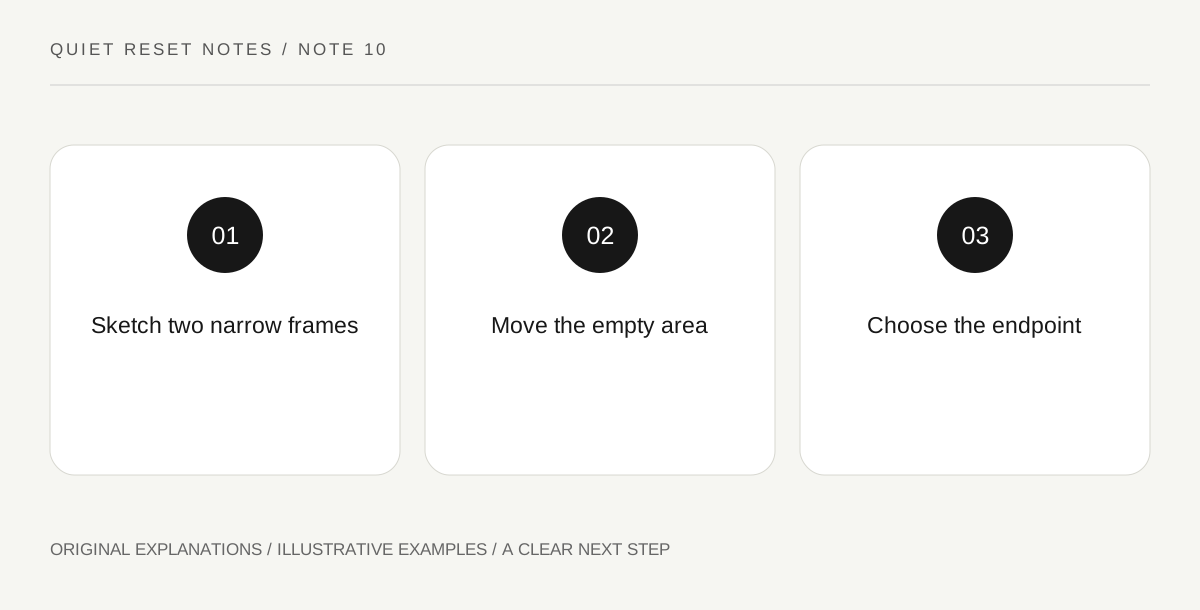
Original explanatory diagram. Read the full method and limitations below.
Draw two loose narrow frames
Use a small sheet and sketch two tall rectangles with a comfortable tool. They need not be measured or cut out. Leave enough room between them to compare the designs. The Gallery’s line and shape resources offer general visual vocabulary, while this paired-bookmark prompt is our own. If you want a physical bookmark later, choose a size and material suitable for your own book, but do not make that finishing task a condition of beginning the drawings.
Place the empty area deliberately
In the first frame, leave the top portion mostly open and put a few lines or shapes below. In the second, keep the bottom open and put the main marks above. You can use the same motif in both to make the difference easy to notice. The empty area is a chosen part of the design, not an unfinished space that must be filled. A small number of marks makes the comparison clearer than dense decoration from edge to edge.
Try one border change
Add a short border on one side of each frame, or let a motif approach an edge without crossing it. Choose only one change so you can see its effect. There is no need for lettering, quotes or a color scheme unless you want them. If a mark lands differently from your plan, include it in the design or leave it visible. The activity is about arranging a narrow surface, not producing a flawless gift that must withstand close inspection.
Choose sketch or object as the endpoint
You may keep the pair as design studies, choose one to redraw on a suitable scrap or simply use the page as a note inside your own book. Avoid bulky or unsuitable materials that could damage a valued volume. A physical finish is a separate choice, not proof that the session was worthwhile. Give the pair a plain title describing the empty-space difference and put the materials away when you have explored that one relationship.
An illustrative small session
In an invented session, one narrow sketch has a leaf-like mark at the bottom and an open top; the other reverses those roles. Their maker adds a single side line, compares the pair and keeps the page without cutting it. This example demonstrates composition choices and claims no therapeutic result, professional design standard or required finished product.
Questions that come up
Is blank space a sign that the design is incomplete?
No. You can choose it deliberately to compare how marks relate to an open area. The exercise does not require filling the entire bookmark shape.
Must I cut and finish the bookmark afterward?
No. The paired sketches can be the complete activity. If you later make an object, use materials and a process suitable for your book and comfortable for you.
References and scope
These sources support the factual background. Examples and exercises are original illustrative teaching material. References do not imply endorsement.
- National Gallery of Art — shape — Geometric and organic shapes and composition vocabulary.
- National Gallery of Art — line — Line as an element of visual art; supports vocabulary, not a therapeutic outcome.