Draw a small sound map with near and far marks
A sound map can be a small drawing rather than a complete inventory of everything you hear. From an ordinary suitable place, use a few marks to represent sounds that seem near or far. This original visual activity has no required count, recording task or expectation that the surroundings become quiet.
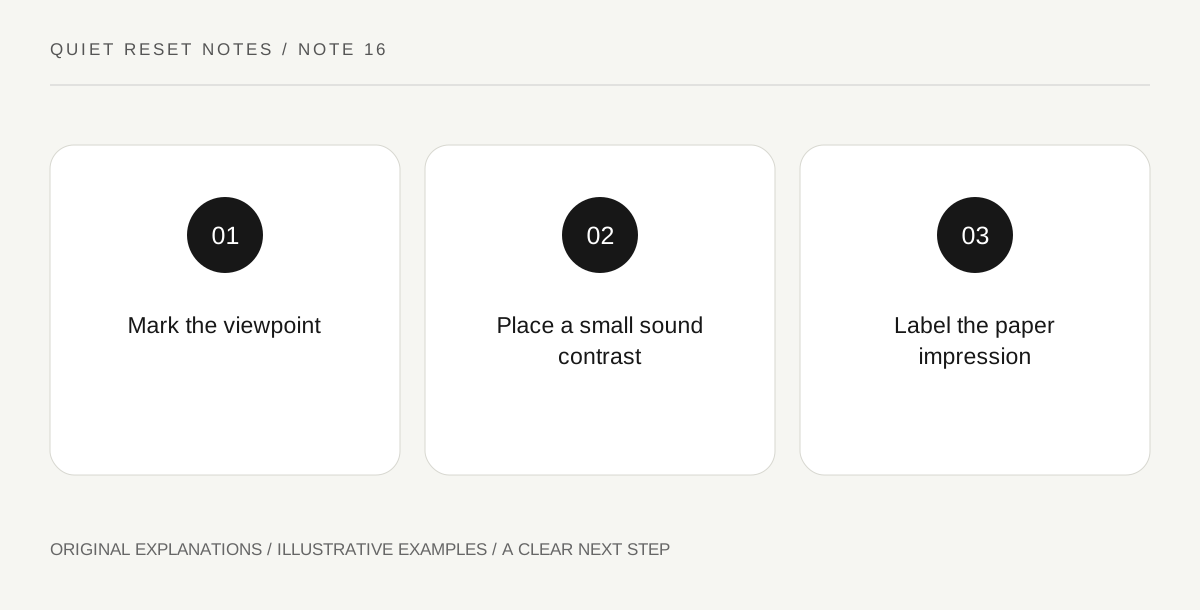
Original explanatory diagram. Read the full method and limitations below.
Choose a place that permits a pause
Sit or stand comfortably where listening will not interfere with driving, work or essential supervision. Keep ordinary awareness of the setting. The National Park Service uses soundscape layers as an educational subject; this near-and-far paper map is our own small variation. You do not need a natural setting or a perfectly silent room. If sound-focused attention is uninviting, choose another creative activity or make a visual map of nearby and distant objects instead.
Put your viewpoint on the page
Draw a small central mark for the place from which you are listening. Choose one sound and place a symbol relatively near or far from that center according to your impression. The position is not a measured distance or an accurate direction-finding result. A short line might represent a steady hum and a loose curve an intermittent sound. Make a private legend if useful, but avoid identifying or recording other people’s conversations.
Add one contrast instead of a complete catalog
Choose another sound that differs in distance, duration or texture and give it a different mark. Leave room between the symbols. You can notice that a sound changed without needing to find its precise source or explain its meaning. The map is a brief impression, not scientific monitoring. If the surroundings are noisy, represent a broad layer rather than trying to separate every part. Two or three understandable marks can be enough for a finished small composition.
Give the drawing a time label
Add a broad private label such as afternoon room or garden pause, avoiding a precise personal location if you plan to share it. Compare the marks as a visual arrangement and then return to the next ordinary activity. No sound recording or upload is required. You can keep the map beside another drawing or recycle it. The endpoint is the small visual response, not achieving a particular state of attention or waiting for an uncomfortable sound to disappear.
An illustrative small session
Imagine a reader making a center mark, a nearby dotted patch for a gentle appliance sound and a distant curved line for passing traffic. They label the page afternoon room and stop after those contrasts. This invented example is neither an acoustic measurement nor a clinical grounding protocol, and it makes no promise about the reader’s mood.
Questions that come up
Must I identify the exact source of each sound?
No. Describe the impression with a mark and leave the source unknown if needed. The activity is a small creative map, not a test of identification or direction-finding skill.
What if sound-focused attention is uncomfortable?
Choose a different activity or use a visual near-and-far map instead. There is no need to persist with an uninviting focus or produce a particular number of sound symbols.
References and scope
These sources support the factual background. Examples and exercises are original illustrative teaching material. References do not imply endorsement.
- National Park Service — soundscape learning — Distinguishing layers in a soundscape as an educational activity.