Observe one leaf through an outline, a few words and one question
One visible leaf can supply a small observation page without needing a botanical identification. Make an approximate outline, write a few visible details and leave one question open. This original activity keeps looking, describing and wondering distinct, so the notebook does not become a test of nature knowledge.
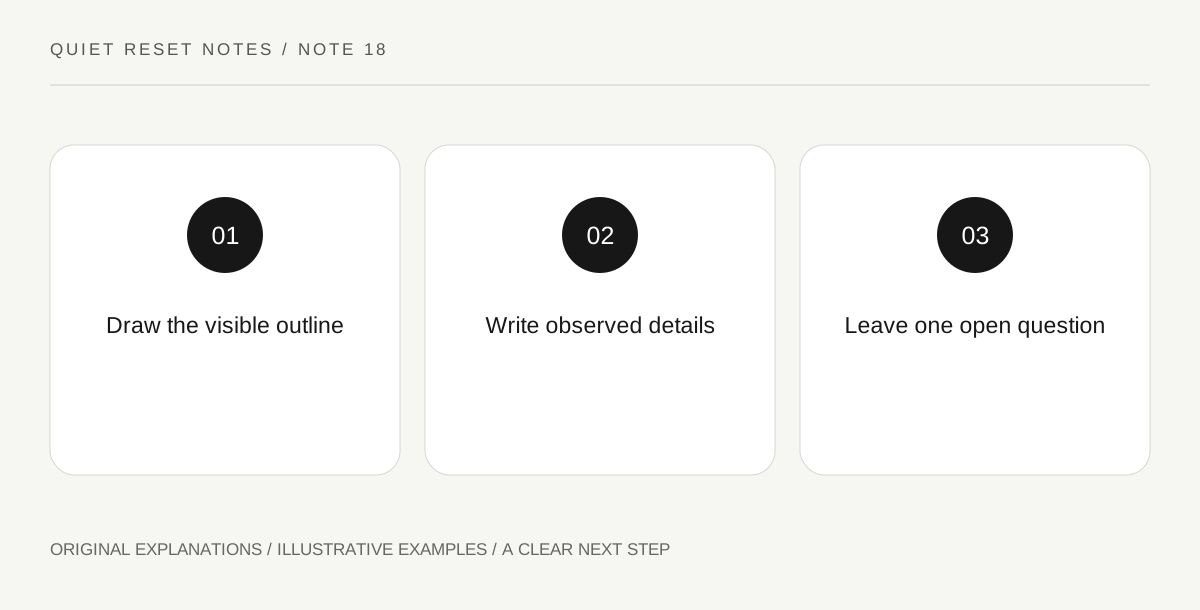
Original explanatory diagram. Read the full method and limitations below.
Choose an ordinary accessible view
Look at a leaf on a plant you can observe from a comfortable permitted place, or use one already appropriately available at home. Do not pick material from a protected area or disturb a plant for the activity. The National Park Service’s cited past educational event describes nature journaling through sketches, notes and questions; it is background rather than a current event invitation. Our three-record prompt can happen without a journey, specialist equipment or a close-up photograph.
Sketch the broad outline
Draw the approximate outer shape from your chosen viewpoint. Leave details that are difficult to see unresolved. A leaf partly hidden by another can remain partly hidden on the page; you do not need to move the plant or leave your suitable position to complete it. Use a few comfortable marks rather than an accurate specimen drawing. The outline records what you noticed from that view, not a claim that every leaf of the same kind has exactly that form.
Write observation before interpretation
Add a few plain details about visible color, edge or orientation. If a color word feels uncertain, use a comparison such as darker near one side rather than inventing a botanical term. Keep guesses separate from observations. Then write one genuine question, perhaps about why this particular leaf faces a different direction from its neighbor. You do not have to answer it during the session. A question can be a useful part of the record without becoming homework.
Choose whether curiosity continues
You can leave the page as a small observation or later consult an appropriate reliable nature reference if you want an answer. Do not use the sketch to decide that an unknown plant is edible, harmless or suitable for a remedy. The activity has no collecting, tasting or handling requirement. End by returning attention to your surroundings and ordinary plans. A modest outline, a few words and an open question form a complete page even when the plant’s name remains unknown.
An illustrative small session
Imagine a reader looking at a leaf on their own houseplant. They draw its tilted outline, note that one side appears darker and ask why two neighboring leaves point differently. They leave the question unanswered and put the notebook away. The invented example is an observation activity, not a plant identification, cultivation instruction or evidence of a particular wellbeing effect.
Questions that come up
Must I identify the plant to finish the page?
No. An outline, observations and a question can stand alone. Identification can be a separate later interest rather than a requirement for a short creative pause.
Can the sketch tell me whether a plant is safe to taste?
No. Do not use this activity for edibility, medicinal or safety decisions. It requires no tasting or handling and does not establish the identity or properties of a plant.
References and scope
These sources support the factual background. Examples and exercises are original illustrative teaching material. References do not imply endorsement.
- National Park Service — nature-journal example — Dated 2026 educational example of sketches, observations and questions. The past event is not advertised as currently available.