Invent written sound words for a tiny imaginary scene
A page can suggest sound without playing or recording anything. Invent a few written sound words for a fictional scene, then vary their spacing and shape. This original activity combines language and drawing, with an imaginary setting that can remain as quiet, busy or peculiar as you want.
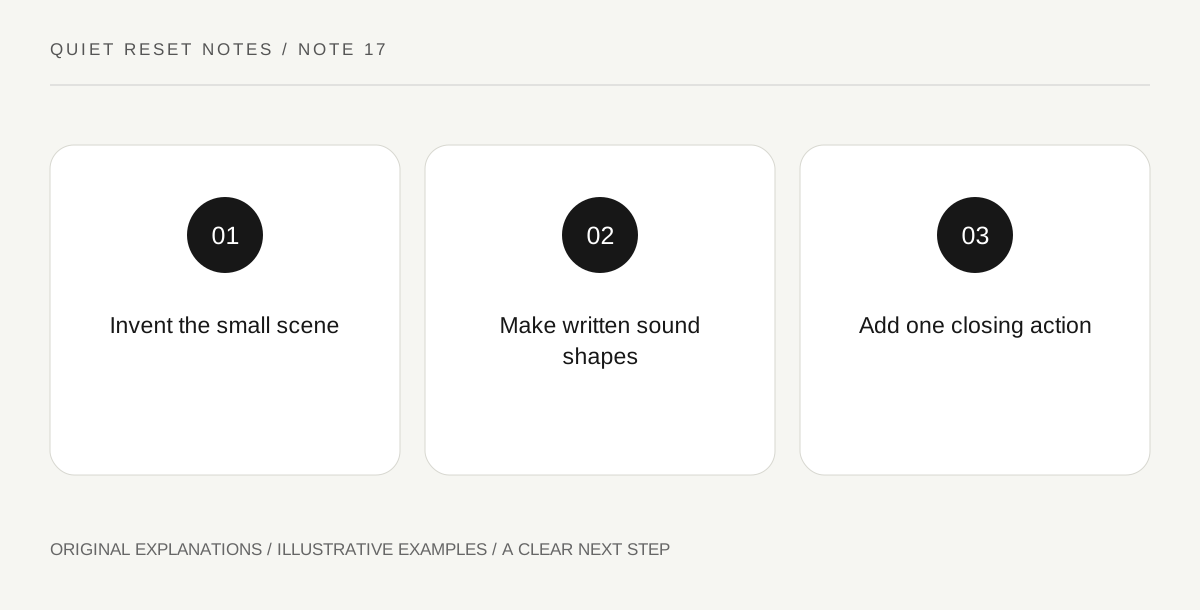
Original explanatory diagram. Read the full method and limitations below.
Choose a wholly invented scene
Pick a modest setting such as a kitchen for paper birds or a station for umbrellas. Use no real private conversation or identifiable person. You can think about sounds from memory, invent them or begin from a visual movement instead. The National Park Service’s soundscape reference supplies general context for distinguishing sound qualities, while the written-sound scene is our own creative prompt. It does not require a good ear, accurate imitation or any sound playing in the room.
Make a small vocabulary
Write two or three short invented sound words. A soft repeated syllable might belong to a fictional machine; a long uneven word might suggest an imaginary sliding door. They do not need dictionary spelling or a standard comic-book form. Say them privately only if that is comfortable and suitable, or leave them entirely on the page. Choose words that are enjoyable to look at rather than trying to reproduce an actual sound with scientific accuracy.
Change the visual rhythm
Write one word with generous gaps between letters and another as a compact cluster. Let a third travel along a loose curve. You can alter the size of a letter or repeat part of a word, but keep the marks comfortable to make. Notice how the written shape changes the impression even without hearing anything. This is your own visual interpretation, not a universal rule that particular lettering must sound a certain way to every reader.
Connect the words with one small action
Add a sentence explaining what happens in the imaginary scene: the umbrella train arrives, a paper bird opens a cupboard or the machine finishes folding clouds. Keep it short enough that the sound words remain the main feature. A title can complete the page. No recording, performance or publication is needed, and a reader who does not want a narrative can simply keep the words as an abstract lettering study with different visual rhythms.
An illustrative small session
In an invented umbrella station, a maker writes a long shoooo word along a curve and a compact tik-tik near a small door shape. Their closing sentence says that the umbrella train has arrived. The original example illustrates a fictional lettering game, not a quotation, a real sound transcript or a claim about hearing, attention or relaxation outcomes.
Questions that come up
Do I need to hear the sounds in the room?
No. They can be wholly invented or based on an imagined visual movement. The activity can remain silent and does not require matching a real sound.
Must another person understand the sound words?
No. They can be a private visual vocabulary. If you share the page with a willing companion, different interpretations can be part of the game rather than evidence that one version is wrong.
References and scope
These sources support the factual background. Examples and exercises are original illustrative teaching material. References do not imply endorsement.
- National Gallery of Art — line — Line as an element of visual art; supports vocabulary, not a therapeutic outcome.
- National Park Service — soundscape learning — Distinguishing layers in a soundscape as an educational activity.