Share one abstract line and let two people give it different meanings
A small shared drawing can be a game of different interpretations rather than a collaborative masterpiece. With a willing companion, begin from one abstract line and let each person make a separate small response. This original activity keeps agreement about the process while allowing the pictures themselves to diverge.
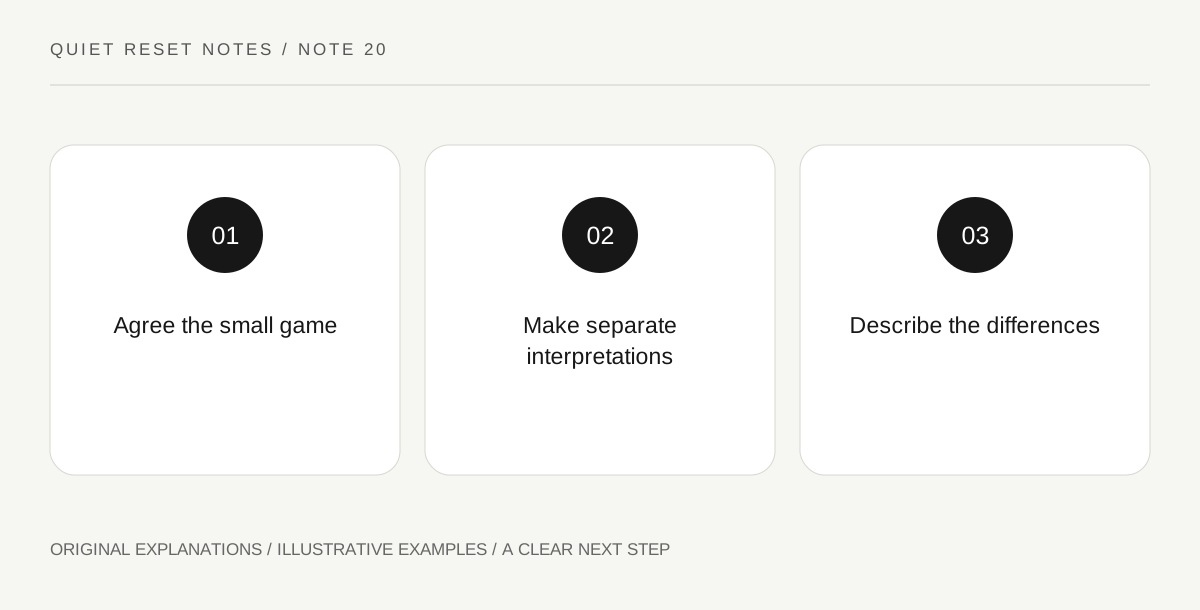
Original explanatory diagram. Read the full method and limitations below.
Agree on a small voluntary game
Ask a companion whether they want to try a brief drawing activity and accept a no without persuasion. Choose comfortable familiar materials and a surface each person can use. Make one loose abstract line, then provide each person with a version to respond to through a simple copy or another agreed method. The Gallery’s line resource supports general visual vocabulary; the two-response game is our own. It is ordinary shared leisure, not a relationship assessment or a therapeutic exercise.
Choose separate meanings quietly
Each person looks at the line and imagines what it could become: an invented path, part of an animal, a roof or something abstract. Let both develop their own response before one explains a preferred interpretation. This prevents the first suggestion from becoming an answer key. You can add a few comfortable marks or write a short caption instead of drawing. The two responses do not need equal detail, matching skill or a shared fictional world.
Describe before judging
When both are ready, each person can say what they chose to see and which small addition mattered. Keep the conversation about the page rather than what the interpretation supposedly reveals about the maker. A line becoming a cloud in one version and a bridge in another is simply an interesting difference. Do not turn the game into a contest, a personality reading or an instruction to compliment a picture in a particular way. Curiosity is available without requiring agreement.
Choose whether there is another round
Finish after the pair if that is enough. If both want another, let the other person supply a different starting line and change only that part of the process. Keep the endpoint easy to recognize so that shared leisure does not become a commitment one person must continue for the other. The drawings can remain separate, be placed beside each other briefly or be put away. Nothing needs to be posted, scored or preserved as a joint finished product.
An illustrative small session
Imagine two willing companions beginning from the same loose curve. One adds a roof and calls it a traveling house; the other adds a few marks and calls it a cloud parade. They describe the different additions, enjoy the contrast and stop after one pair. This original fictional scenario is not an account of real participants or evidence about their personalities or wellbeing.
Questions that come up
Do both people need similar drawing skills?
No. A written caption or a few marks can be a complete response. The game concerns different interpretations of a shared starting line, not matching technique or producing equally detailed pictures.
Can I do a solo version?
Yes. Put two copies of a loose line on the page and give them different meanings. You can choose a second interpretation without needing another participant or pretending it reveals something about your personality.
References and scope
These sources support the factual background. Examples and exercises are original illustrative teaching material. References do not imply endorsement.
- National Gallery of Art — line — Line as an element of visual art; supports vocabulary, not a therapeutic outcome.