Make a tiny imaginary garden from dots and open spaces
Dots can suggest a garden without drawing a single realistic plant. On a small page, place a few clusters and leave paths of open paper between them. This original activity turns density and spacing into a simple design choice, with no need to identify plants, copy a botanical illustration or plan an actual garden.
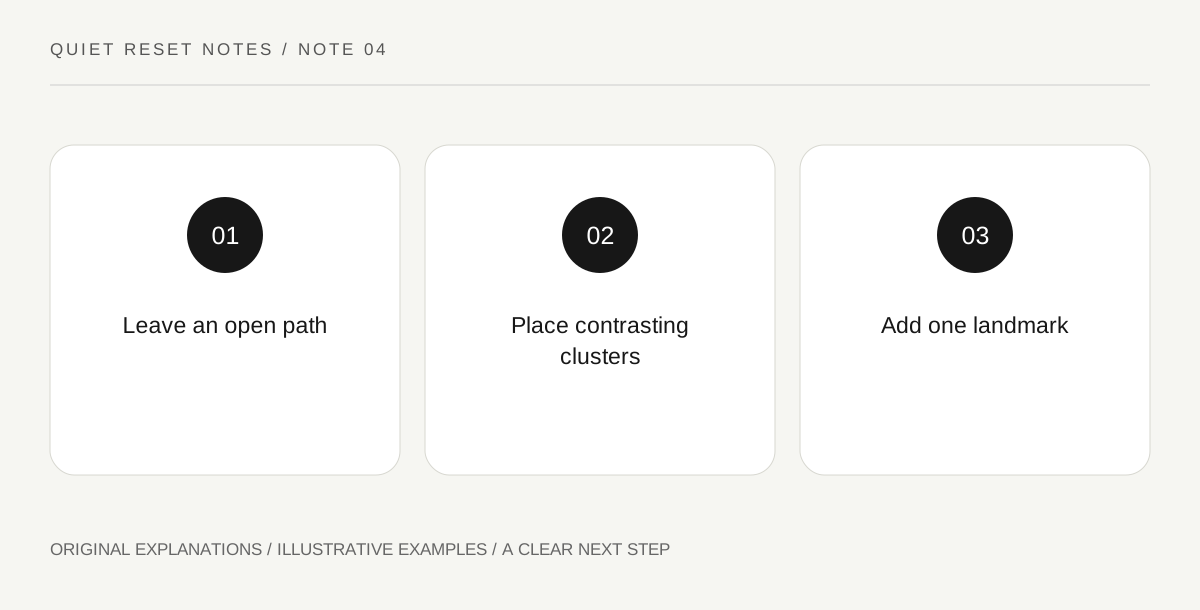
Original explanatory diagram. Read the full method and limitations below.
Choose the page’s open path
Draw a loose boundary for a postcard-size area and imagine a path through it. Leave that path unmarked for now. It might curve once or pass between two broad areas. You can lightly indicate its edges if that helps, but exact measurement is unnecessary. The Gallery’s drawing resource provides general mark-making vocabulary; this dot-garden recipe is our own. Use a tool that makes comfortable marks and avoid repeated pressure if your hand prefers a different movement.
Build a few different clusters
Place a small group of dots in one area and a more spread-out group elsewhere. Let another area remain mostly blank. The clusters can suggest beds, islands or simply patches of pattern. There is no required total and no reward for the largest number of dots. If dots feel tedious, substitute small dashes or loose circles while keeping the idea of clustered and open areas. The activity is about arrangement rather than proving patience through repetition.
Add a single visual landmark
Choose one larger mark, a ring or a small outlined shape as the garden’s landmark. Place it where the open path seems to lead, then look at how it changes the page. You can relocate an imagined landmark in a second miniature drawing instead of erasing the whole first attempt. Avoid adding many competing symbols just because the initial page was easy. One landmark keeps the small design readable and gives the eye a place to arrive.
Give the invented place a modest identity
Name the garden after something visible on the page, such as loop path or three quiet patches. If you want, add a simple legend using your own symbols. The legend should describe the drawing, not create instructions for real planting. End when the arrangement feels complete enough to recognize as your invented place. The page can become a private bookmark image or remain an unfinished scrap, with neither outcome requiring a public presentation.
An illustrative small session
In an illustrative session, a reader leaves a curved white path, adds two loose dot clusters and places one ring at the end. They call it ring garden and make no attempt to turn it into a botanical plan. When dotting becomes uninteresting, they stop rather than filling every area. This invented example establishes no therapeutic effect or horticultural recommendation.
Questions that come up
What if making repeated dots is uncomfortable?
Choose dashes, circles or a different activity. The design idea can be explored without any prescribed repeated movement, and no particular mark is required for the page to count.
Does the garden need realistic plant symbols?
No. It is an invented arrangement of clusters, paths and a landmark. A simple private legend can describe your symbols without claiming they represent actual species or planting instructions.
References and scope
These sources support the factual background. Examples and exercises are original illustrative teaching material. References do not imply endorsement.
- National Gallery of Art — drawing everyday objects — General mark-making and contour terminology; our small exercises are original editorial designs.