Draw the empty gaps between three simple objects
Change the subject of a small sketch from things to the spaces between them. Arrange three suitable objects and draw one or two visible gaps, leaving the objects themselves mostly absent. This original paper exercise makes an ordinary tabletop into a collection of abstract shapes without requiring a realistic finished picture.
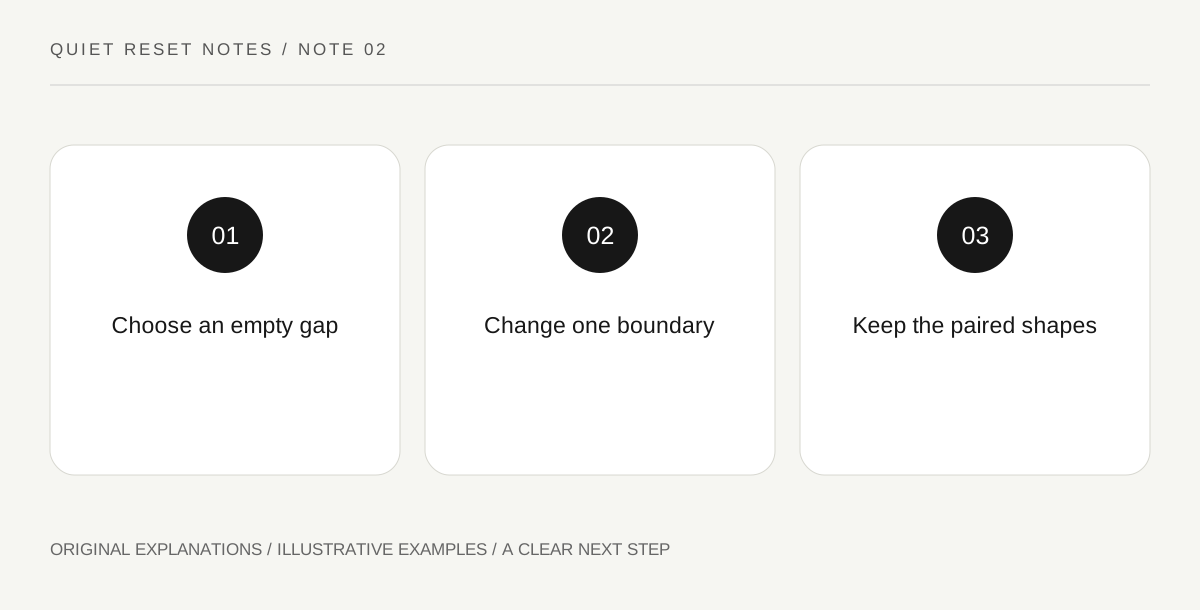
Original explanatory diagram. Read the full method and limitations below.
Arrange a manageable group
Choose three small stable objects you can comfortably move, such as a closed notebook, an empty container and a block. Place them with visible gaps and view them from a seated position. Keep fragile, sharp or important working items out of the arrangement. Use a small page rather than making room for an elaborate still life. The Gallery’s shape resource offers general art vocabulary; the particular gap-drawing game here is an independent editorial activity.
Choose one gap as the whole subject
Look for a space bounded partly by the objects and partly by the surrounding surface. Sketch its approximate outline as though that empty area were a paper piece you could lift. Do not begin by drawing every object accurately and filling the gap afterward. Let the gap take the center of the page. Its edges may feel unfamiliar because the shape has no ordinary object name, which is the interesting part of this change in subject.
Move one object and make a companion shape
Shift one item a little while keeping the group stable. On another part of the page, draw how the chosen gap has changed. You might notice that a narrow opening has widened or a triangular area has become more irregular. Describe only what you can see; no geometric calculation is necessary. If moving the objects is inconvenient, choose a different visible gap instead. The activity remains a comparison between two spaces rather than a test of precise proportions.
Turn the pair into an abstract card
Add a simple border around the two shapes or give each a plain descriptive label. You can shade one lightly while leaving the other open, but additional decoration is optional. Put the objects back where they belong and keep the small page only if you want it. Ending includes restoring the surface, so the leisure activity does not leave a large arrangement waiting to be dealt with. The drawing can remain an abstract record of a small visual experiment.
An illustrative small session
In an invented session, a reader arranges a notebook, an empty tin and a wooden block. They sketch the gap beside the tin, move the block and draw the wider opening alongside it. They title the shapes narrow passage and open corner, then restore the tabletop. The example illustrates the activity and claims no measured change in mood, concentration or stress.
Questions that come up
Must I know the formal term negative space?
No. The practical instruction is to draw an empty gap rather than the objects around it. Art vocabulary can be interesting afterward without becoming an entry requirement.
Can the result be completely abstract?
Yes. An unfamiliar outline is a suitable result. You can keep the two shapes as a small abstract card instead of trying to make viewers recognize the original tabletop arrangement.
References and scope
These sources support the factual background. Examples and exercises are original illustrative teaching material. References do not imply endorsement.
- National Gallery of Art — shape — Geometric and organic shapes and composition vocabulary.