Give one ordinary mug two very different outlines
A familiar mug can supply a small drawing session without becoming a realistic still-life assignment. Use two views on the same page: one broad silhouette and one deliberately simplified outline. This original exercise gives the pencil a modest job, with a finished pair rather than an open-ended demand to draw well.
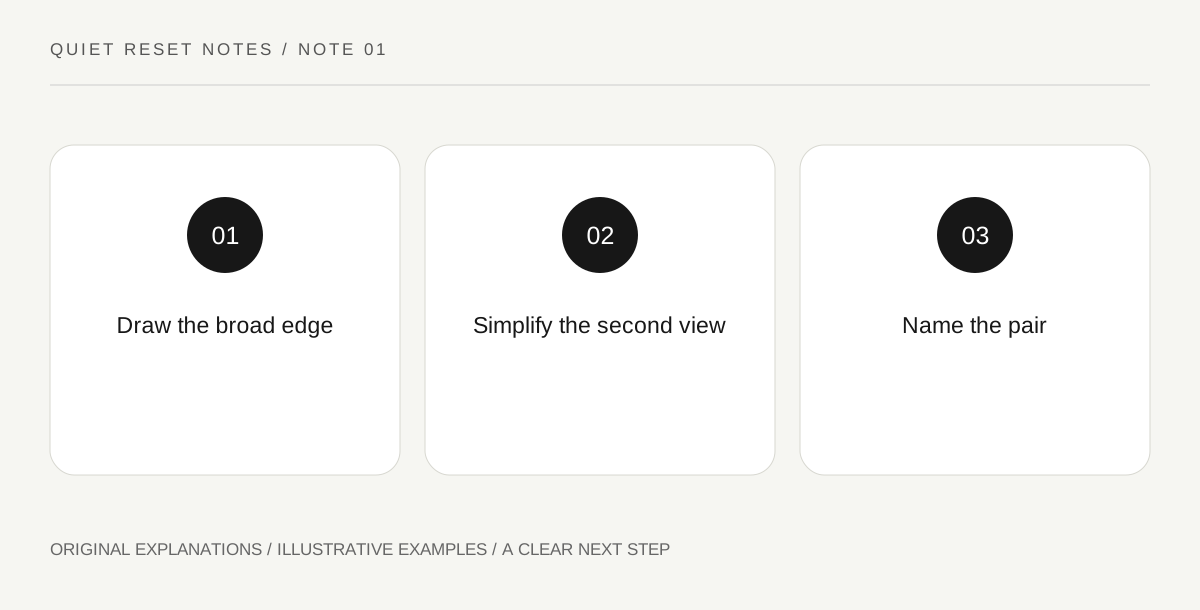
Original explanatory diagram. Read the full method and limitations below.
Choose a stable subject and a small page
Use an empty, unbreakable or otherwise suitable mug on a stable surface where it will not interrupt another task. Set a small sheet beside it and leave room for two drawings. You need only an ordinary pencil or pen that feels comfortable to use. The National Gallery’s drawing resource supplies general contour and mark-making vocabulary; this paired-outline recipe is our own. Do not arrange a complicated studio or add objects simply to make the activity look more serious.
Draw the broad silhouette
Look at the mug as a shape against its background. Start with its widest extent, then sketch the outside edge in several comfortable marks. Include the handle only as the broad form you can see. Leave lettering, reflections and shading out of this first view. If a line wanders, let it remain part of the sketch rather than repeatedly correcting it. The constraint is useful because it tells you what belongs on this drawing and what can be ignored.
Make the second view intentionally simpler
Beside the first drawing, make a second mug using a small number of chosen marks: perhaps two sides, a base, a rim and a handle curve. These are examples, not a required count. Compare how much information the simplified version still carries. If you want a variation, exaggerate one feature such as the width of the handle while leaving everything else plain. The second view is a different interpretation, so it does not have to repair the first one.
Choose a title for the pair
Give the drawings short descriptive names, such as tall outline and wide handle. Avoid a good-versus-bad label. You can note which mark was enjoyable to make or which shape surprised you, then put the page away. There is no need to add color, photograph it or continue until the proportions match. The pair has a natural endpoint because both views are present; a later session can use a different object rather than endlessly improving this one.
An illustrative small session
Imagine a person drawing a sturdy blue mug after lunch. Their first sketch follows the broad edge, while the second reduces the mug to a few curved marks and an oversized handle. They name the pair ordinary cup and generous handle and stop there. This is an invented creative session, not a report of a tested relaxation result or a requirement to feel a particular emotion.
Questions that come up
What if the drawing does not resemble the mug?
You can keep it as an invented shape or try another broad outline. Resemblance is not required for the paired activity, and you do not need to repair every mark before stopping.
Do I need a special contour technique?
No. Use ordinary comfortable marks. The museum reference explains vocabulary for readers who want it, but this original activity does not require following a formal classroom sequence or buying particular pencils.
References and scope
These sources support the factual background. Examples and exercises are original illustrative teaching material. References do not imply endorsement.
- National Gallery of Art — drawing everyday objects — General mark-making and contour terminology; our small exercises are original editorial designs.