Invent four kinds of weather using only lines
A line can curl, lean, break or travel across a page without needing to become a polished picture. Divide a small sheet into four loose areas and invent a different kind of weather in each. The weather is fictional, so the session can remain a playful mark-making task rather than an observation exercise.
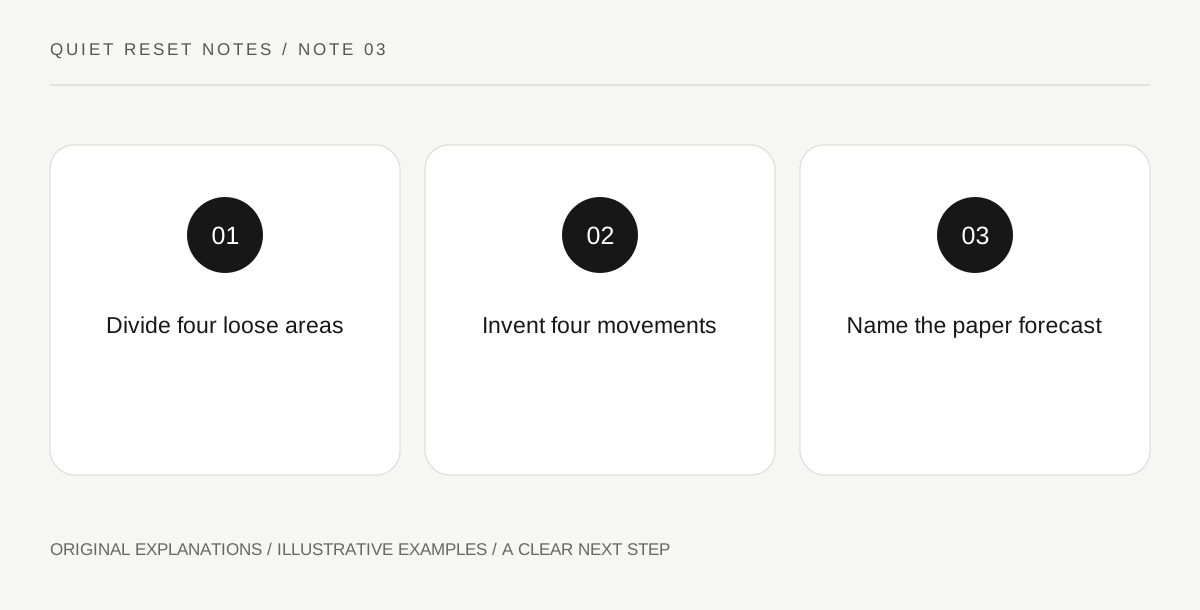
Original explanatory diagram. Read the full method and limitations below.
Make four generous areas
Use a pen or pencil and mark four rough spaces on a small sheet, leaving room between them. They do not need equal measurements or ruler-straight borders. Choose a comfortable grip and a page position that works for you. The National Gallery’s line resource gives general background on line as an art element; these four invented-weather prompts are our own. No one needs to know meteorological categories or produce a picture that could be used as a forecast.
Choose a movement for each area
Give the first area a few long leaning lines, another gentle loops, another short scattered marks and the last a path that changes direction. These are starting suggestions; replace any movement that feels awkward. Let the marks suggest wind, drizzle, drifting or something with an invented name. Keep the differences visible by choosing one main movement per area. You are making a small vocabulary of marks rather than filling every blank place on the sheet.
Change spacing instead of adding equipment
Choose one area and see how it looks when marks sit farther apart or closer together. You can make that comparison within the same box or on a scrap beside it. Do not press harder to force an effect or buy a special tool. A different gap between marks may be enough to create another visual rhythm. If the page starts to feel crowded, leave the remaining space empty rather than turning the activity into a coverage target.
Name the imaginary forecast
Give each area a short playful label that describes its lines, such as sideways afternoon or drifting curls. A label can be literal or invented without explaining a personal feeling. Put the sheet aside when the four areas have distinct identities. You may choose a favorite movement to repeat another day, but there is no need to rank the drawings by skill. The small forecast belongs to an imaginary place and can simply be a finished set of marks.
An illustrative small session
Imagine a person making leaning rain, floating loops, tiny gusts and a wandering breeze on one page. They leave generous white spaces and name the set weather for a paper town. One box stays almost empty because its few marks already make a clear contrast. The invented session describes a drawing game, not a scientific weather record or a tested wellbeing intervention.
Questions that come up
Do the marks have to represent real weather?
No. They can be fictional movements with invented names. The point is a small set of contrasting line choices, not an accurate image or a meteorological classification.
Must every box be filled?
No. Empty space is available to use deliberately. A few marks can complete an area when they establish the contrast you wanted, and you can end before the page feels crowded.
References and scope
These sources support the factual background. Examples and exercises are original illustrative teaching material. References do not imply endorsement.
- National Gallery of Art — line — Line as an element of visual art; supports vocabulary, not a therapeutic outcome.