Write an imaginary museum label for one ordinary object
A familiar object can become interesting when it receives a tiny exhibition label. Choose something ordinary and write a few descriptive lines, then add one clearly fictional detail. This original writing game gives everyday attention a small container without requiring a personal journal entry, a meaningful confession or a polished story.
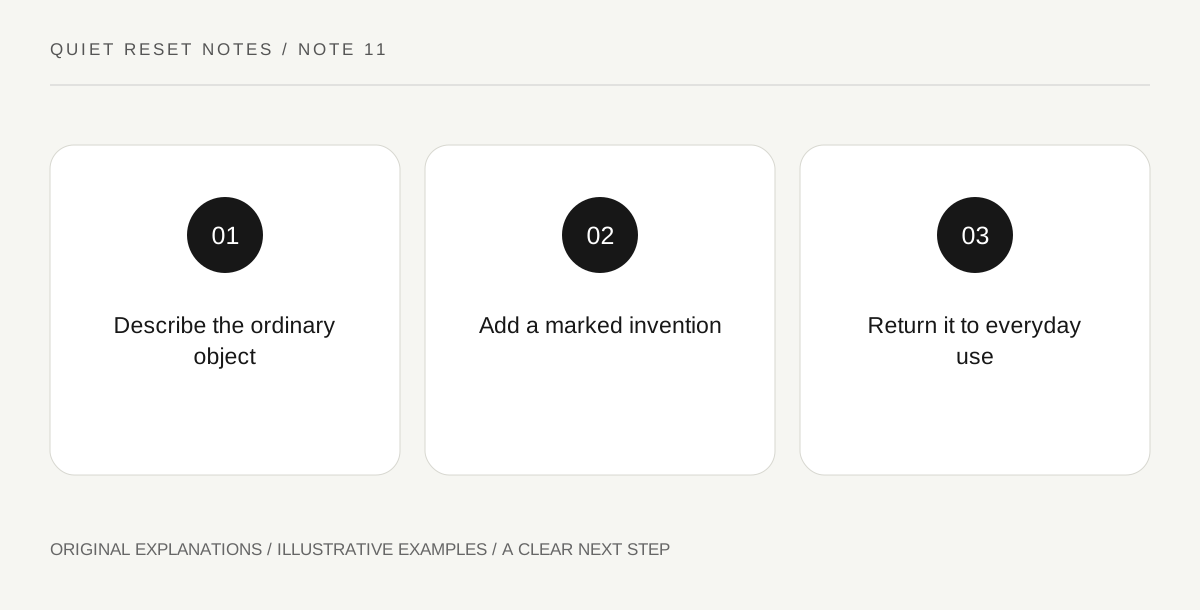
Original explanatory diagram. Read the full method and limitations below.
Choose an object without a difficult history
Use something uncomplicated that is yours to observe, such as an empty pencil case, a spoon or a plain button. Leave valuable, private or emotionally demanding material aside if it does not suit the moment. Place the object where it can remain undisturbed and use a small scrap for the label. The activity is an original leisure prompt within the NHS’s broad context of making time for enjoyable things; it is not a museum cataloging standard or a therapeutic writing protocol.
Write three visible facts
Describe its shape, surface or ordinary function in short plain sentences. Keep the observation separate from assumptions about where it was made or who previously owned it. If you do not know a material, describe what you can see rather than inventing a precise identification. You can make the description playful without turning uncertainty into a fact. The small factual portion gives the fictional addition something stable to stand beside and prevents the game from requiring a complicated invented biography.
Add an openly imaginary exhibit detail
Choose a fictional title or an invented role, such as Official Spoon of the Cloud Café. Mark the addition as imagined so it does not look like a claim about a real collection or history. A single fanciful sentence is enough. You do not need to explain an entire imaginary institution, write an auction description or pretend the object has special value. Let the contrast between an ordinary thing and a grand little label carry the joke.
Choose the label’s final form
Place the scrap beside the object briefly, read it privately or let a consenting companion guess which part is fictional. Then return the object to its normal use. Keep the label if it amuses you, or reuse the paper. The activity finishes when the small description and invented addition are present. It does not need a photograph, a social-media post or a series of twenty objects before it becomes a complete creative pause.
An illustrative small session
Imagine a plain teaspoon receiving three ordinary observations and the fictional title Deputy Stirrer of Raincloud Tea. Its maker marks that title as invented, reads the small label and returns the spoon to the drawer. The scenario is an original writing example, not a real museum attribution, provenance claim, valuation or report of a mental-health outcome.
Questions that come up
Must the label describe an important object?
No. An ordinary object gives the game its contrast. You can choose something with no special personal story and still make an interesting small description.
May I invent historical facts for a real collection item?
Do not present invention as history. In this private game, clearly mark the fictional part and avoid implying that an actual museum, maker or past owner supplied it.
References and scope
These sources support the factual background. Examples and exercises are original illustrative teaching material. References do not imply endorsement.
- NHS Every Mind Matters — wellbeing tips — General context for enjoyable activities and time for oneself, not clinical validation of these original exercises.
- National Gallery of Art — drawing everyday objects — General mark-making and contour terminology; our small exercises are original editorial designs.