Draw an imaginary transit line with three very different stops
An invented transit map can give a wandering line a small story. Draw one route and three fictional stops, then let each stop have a different shape or purpose. Because the place does not exist, the activity needs neither accurate geography nor personal addresses, and it can end with one compact paper journey.
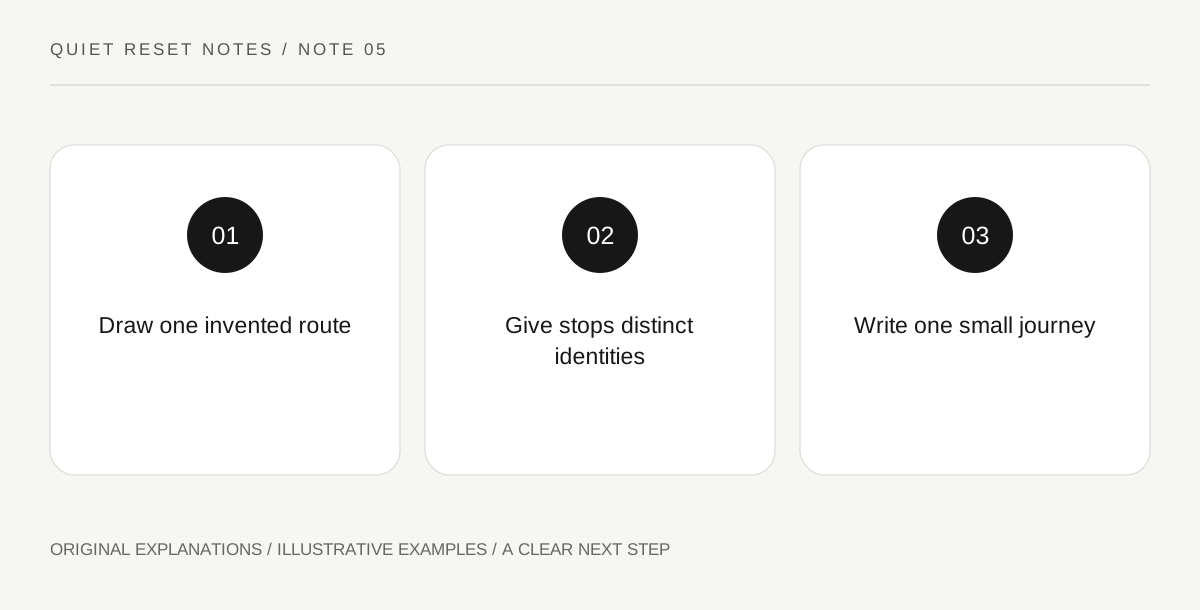
Original explanatory diagram. Read the full method and limitations below.
Choose a fictional setting
Give the place a working name such as Paper Harbor or Button Town. Draw one line across the page with a bend or loop if you like. It does not need to resemble an actual transit system. Use ordinary line and shape vocabulary from art education as background, while treating the map as your own invention. Keep real home, work and other private locations out of it so that the small design is freely fictional rather than a record of someone’s routine.
Place three distinct stops
Choose three positions on the line and give each a different simple symbol. One might be a square for a reading room, another a circle for a cloud market and a third a triangle for a hill of kites. These are examples to replace. The stops should differ enough to suggest a journey without requiring a full city plan. Leave the spaces between them generous. A line with only three destinations can have more character than a crowded page of names you do not want to invent.
Add one route rule
Make a single playful rule for the imaginary line: it runs only clockwise around its loop, changes its name halfway or pauses at the cloud market. Keep the rule understandable in one sentence. You do not need timetables, fares or engineering realism. If a rule makes the map confusing, simplify the drawing rather than explaining it in a paragraph of exceptions. The small constraint is there to make invention enjoyable, not to produce a system that someone could actually operate.
Take the journey in a few words
Write one sentence about traveling from the first stop to the last, using only the fictional setting. You might describe what a passenger carries or what changes outside the window. End after the sentence and give the map a title. A second route can wait for another session. This lets the page finish as a small combination of line, symbols and story instead of becoming a project that requires a complete world before it can be put away.
An illustrative small session
Imagine a map called Paper Harbor with a reading-room square, a cloud-market circle and a kite-hill triangle. Its only rule is that the tram pauses at the market. The maker writes that a passenger carries a folded blue kite to the hill, then stops. The example is an invented drawing-and-writing game, not a real transit guide or an outcome claim.
Questions that come up
Must the map obey real transit conventions?
No. It is a fictional creative activity. Simple readable symbols help the game, but realistic engineering, fares and timetables are not part of the task.
Can I stop before inventing the surrounding city?
Yes. One line, a few stops and a short sentence form a complete small activity. The undeveloped city can remain outside the page without becoming unfinished work you owe yourself.
References and scope
These sources support the factual background. Examples and exercises are original illustrative teaching material. References do not imply endorsement.
- National Gallery of Art — shape — Geometric and organic shapes and composition vocabulary.
- National Gallery of Art — line — Line as an element of visual art; supports vocabulary, not a therapeutic outcome.